International visitors to Vietnam in September and 9 months of 2010
International visitors to Vietnam in September estimated 383,463 arrivals, increasing by 26.0% over the same period last year. Total international arrivals in 9 months reached 3,731,919 representing a 34.2% growth.
Sep. 2010 (estimate) | Accrued for 9 months of 2010 | Sep. 2010 vs. Aug 2010 (%) | Sep. 2010 vs. Sep. 2009 (%) | 9 months 2010 vs. 9 months 2009 (%) | |
Total | 383,463 | 3,731,919 | 89.6 | 126.0 | 134.2 |
By means of transportation | |||||
By air | 303,463 | 2,990,776 | 88.5 | 136.9 | 132.7 |
By sea | 5,000 | 37,500 | 111.1 | 122.0 | 68.9 |
By road | 75,000 | 703,643 | 93.2 | 93.0 | 149.0 |
By purposes of trips | |||||
Tourism | 229,182 | 2,347,227 | 84.1 | 129.4 | 143.3 |
Business | 83,654 | 757,506 | 94.8 | 108.2 | 139.8 |
Visiting relatives | 34,362 | 424,629 | 80.0 | 117.6 | 102.0 |
Others | 36,265 | 202,557 | 149.4 | 174.3 | 110.0 |
By countries and territories | |||||
77,682 | 675,930 | 89.9 | 139.2 | 189.2 | |
33,861 | 365,379 | 80.0 | 133.4 | 129.4 | |
29,110 | 324,888 | 100.7 | 123.4 | 102.4 | |
40,042 | 317,727 | 107.1 | 103.2 | 118.7 | |
24,006 | 251,692 | 84.1 | 117.8 | 120.7 | |
21,016 | 205,424 | 120.0 | 124.5 | 127.9 | |
24,789 | 189,915 | 110.7 | 137.7 | 192.2 | |
17,627 | 161,659 | 96.7 | 175.0 | 139.5 | |
Malaysia | 17,563 | 149,879 | 105.6 | 135.7 | 123.1 |
9,880 | 147,421 | 49.5 | 99.5 | 112.0 | |
Others | 87,887 | 942,005 | 80.2 | 121.0 | 131.2 |
Tell me all about this name, that is difficult to say.
It was given me the day I was born.
Want to know about the stories of the empire of old.
My eyes say more of me than what you dare to say.
All I know of you is all the sights of war.
A film by Coppola, the helicopter's roar.
One day I'll touch your soil.
One day I'll finally know your soul.
One day I'll come to you.
To say hello Vietnam.
Tell me all about my colour, my hair and my little feet.
That have carried me every mile of the way.
Want to see your house, your streets, Show me all I do not know.
Wooden sampans, floating markets, light of gold.
All I know of you is the sights of war.
A film by Coppola, the helicopter's roar.
One day I'll touch your soil.
One day I'll finally know your soul.
One day I'll come to you.
To say hello Vietnam.
And Buddha’s made of stone watch over me.
My dreams they lead me through the fields of rice.
In prayer, in the light…I see my kin.
I touch my tree, my roots,my begin.
One day I'll touch your soil.
One day I'll finally know your soul.
One day I'll come to you.
To say hello Vietnam.
One day I’ll walk your soil.
One day I’ll finally know my soul.
One day I’ll come to you.
To say hello…Vietnam.
To say hello…Vietnam.
To say xin chào…Vietnam.

Son Doong cave, discovered by a local 18 years ago, is more than 200 meters wide, 150 meters high, and at least 6.5 kilometers long, though the explorers said they were unable to explore it fully. Bristish explorers have recently discovered that So Dong is much larger than the world’s biggest known cave. The biggest section of Son Dong is five kilometers in length, 200 meters high and 150 meters wide, said Howard Limbirt of the British Cave Research Association team searching the area April 10-14, 2009. Son Dong is much larger than Deer Cave in Malaysia, currently considered the world’s largest, an explorer said (Deer is 90 meters wide, 100 meters high and 2 kilometers long). The Son Doong cave has replaced to take pole position as the world’s largest cave.
The Son Dong is situated below another cave in Phong Nha-Ke Bang, though its entry passage is very difficult to traverse. The exploration team said they had set foot on just 6.5 kilometers along the cave, as there is a large amount of fast flowing water inside Son Dong. It takes explorers six hours of walking through a 10 kilometer long forest path from Truong Son Highway to reach the mouth of Son Dong cave. The explorer added that the Quang Binh cave has beautiful stalactites and stalagmites that are not seen anywhere else.
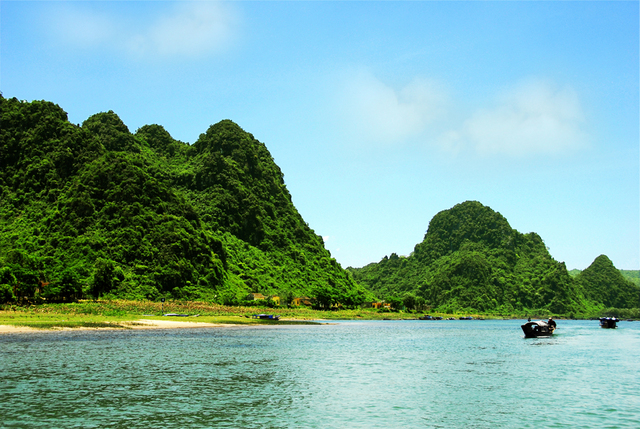
Phong Nha-Ke Bang grotto system belongs to the Phong Nha-Ke Bang National Park. It is a limestone region of 2,000 square kilometers in Vietnam and borders another limestone area in Hin Nammo in Laos. When describing the newly-discovered cave, the team’s spokesman, Haward Limbirt, said that it was a thing of overwhelming beauty and grandeur. He added that each grotto has its own beauty, but he is impressed by Ca Xai. This cave is near the Vietnam-Laos border. It is very deep and has a big lake inside. Explorers measured the depth of this lake, but they had only 200m of rope and the end didn’t reach the lake bed.
The British team suggested to the local authorities not to develop Son Doong Cave as a tourism site immediately to preserve its natural beauty.
(source: Vietnam Beauty)

Phong Nha - Ke Bang is a national park in the center of Quang Binh province in north-central Vietnam. It protects one of the world's two largest karst regions with several hundred caves and grottoes. Its name derives from Phong Nha cave, the most beautiful one, with numerous fascinating rock formations, and Ke Bang forest. The plateau is probably one of the finest and most distinctive examples of a complex karst landform in Southeast Asia.
Location:
Geographically, the Phong Nha-Ke Bang National Park (PNKBNP) is located in central Vietnam, about 500km south of the capital, Hanoi, within the Quang Binh Province.
The western boundary of the Park partially forms Laos-Vietnamese border, which is only 42km from the sea. The Park is found within the geographical co-ordinates of 170 20'-170 48' N and 1050 46-1060 24' E in Bo Trach and Minh Hoa Districts.
Recognition by UNESCO in 2003

Phong Nha-Ke Bang National Park was first nominated as a UNESCO World Heritage Site in 1998. The dossier submited to UNESCO was for the recognition of Phong Nha nature reserve as a world natural heritage under the name “Phong Nha Nature Reserve”. The reason given for the nomination was that this nature reserve satisfied the criteria of biodiversity, unique beauty and geodiversity (criteria I and iv).
It was recognized as a world natural heritage site at the UNESCO's 27th general assembly session being held in Paris in June 30th – July 5th, 2003. At the session, delegates from over 160 member countries of UNESCO World Heritage Convention agreed to include Phong Nha-Ke Bang park and 30 others worldwide in the list of world heritage sites. Phong Nha-Ke Bang National Park meets with criteria viiii in accordance with UNESCO’s appraisal scale since it displays an impressive amount of evidence of earth’s history and is a site of importance for increasing human understanding of the geologic, geomorphic and geo-chronological history of the region.
Physical features:
Criterion (viii): Phong Nha is part of a larger dissected plateau, which also encompasses the Ke Bang and Hin Namno karsts. The limestone incontinuously demonstrates the complexity interbedding with shales and sandstones. This, together with the capping of schists and apparent granites has led to a particularly distinctive topography.
Looking into the caves, you may recognize discrete episodic sequences of events, leaving behind various levels of fossil passages, formerly buried and now uncovered palaeokarst (karst from previous, perhaps very ancient, periods of solution); evidence of major changes in the routes of underground rivers; changes in the solutional regime; deposition and later re-solution of giant speleothems and unusual features such as sub-aerial stromatolites. The location and form of the caves suggest that they might owe much of their size and morphology to some as yet undetermined implications of the schists and granites which overlay the limestone. On the surface, there is a striking series of landscapes, ranging from deeply dissected ranges and plateaux to an immense polje. There is evidence of at least one period of hydrothermal activity in the evolution of this ancient mature karst system. The plateau is probably one of the finest and most distinctive examples of a complex karst landform in SE Asia.
Cultural heritage:
The oldest evidence of human occupation of the area are Neolithic axe heads and similar artefacts found in some of the caves. There are some relics of Ham Nghi King, a final King of the Nguyen dynasty before the French colonial period, at the Maria Mountain in the north of the Park. Currently the Arem, Ma Coong and Ruc ethnic groups live in two villages in the core zone of Phong Nha Ke - Bang National Park. Until 1962 these indigenous people lived in the forest in houses made of bamboo and leaves or in the caves, living from forest products and hunting. They used simple tools and their clothes were made from the bark of a toxic forest tree (Antiaris toxicaria) and lianas.
Since 1992 the Government of Vietnam has set up two new settlements for these 475 people, who are the two smallest ethnic groups in Vietnam. These people are familiar with a number of economically valuable species, especially precious timber such as Mun and Hue (Diospyros spp., Dalbergia rimosa), and oil-extraction from species such as Tau (Hopea hainanensis) and many medicinal plants. The Phong Nha Cave has long been a site of religious and touristic importance, with an old Cham Temple discovered in the cave and it was a site of worship in the ninth and tenth centuries. During the war with the USA the Phong Nha - Ke Bang forest and caves were a garrison and weapons store for the Vietnamese army.
Conservation value:
Phong Nha-Ke Bang National Park is of high conservation value as one of the largest areas of intact forest habitat remaining in Vietnam. As part of a continuous forest block with the neighbouring Him Namno Biodiversity Conservation Area in Laos it forms one of the largest areas of forest on limestone karst in Indochina. The presence of tall lowland forest, which is regionally threatened as a habitat type, in the National Park increases the area's conservation value.
Tourist activities
The number of tourists has increased dramatically since the park was listed in UNESCO's World Heritage Sites. Tourism activities in the area are the responsibility of the Trading and Tourism Department of Quang Binh province, with 280 international standard rooms in the province and 8 vehicles with capacities of 4 to 15 seats for tourist transportation. The forest guards of Son Trach commune in Bo Trach district are placed on tourist security duty.
Quang Binh Province has invested into upgrading the Phong Nha-Ke Bang visitor site to turn it into one of Vietnam's major tourist destinations.
Multiple eco-tourist projects have been licensed for development and the area is being heavily developed by the province to turn it into a major tourist site in Vietnam. Phong Nha Ke Bang is part of a tourism promotion program called: "Middle World Heritage Road" which includes the ancient capital of Hue, the Champa relics of My Son, the city of Hoi An, nha nhac and the Space of Gong Culture in the Central Highlands of Vietnam.
Tourist activities in Phong Nha-Ke Bang National Park are organized by local travel agencies and vary in form:
Tour for expedition of caves and grottos in boats and with professional cave expedtion means.
Ecotourism, discovering the florae and fauna in this national park in the Ke Bang Forest.
Mountain climbing: There are extreme sloping mountains here with a height of over 1,000 m, which is a real challenge for adventurous climbers
In order to facilitate the increasing flow of tourists to the site, the Dong Hoi Airport was constructed and is due to be operational at the end of 2008.
Phong Nha-Ke Bang, together with Ha Long Bay and Fanxipan of Vietnam, is listed as a candidate for 7 new world natural wonders vote. As of February 12, 2008 it ranked 10th in the voting list
In summary, Phong Nha displays an impressive amount of evidence of earth’s history. It is a site of very great importance for increasing our understanding of the geologic, geomorphic and geo-chronological history of the region.
See more photos at http://www.phongnhawonder.com/

Vietnamese Beaches, the best time to go there:
The country has a long coastline, varied, complex climatic zones and generally a fair amount of rain.
The best beaches are mostly in the southern half, and that's best Dec- May [dry, but hot and humid]. However, in that area it doesn't usually rain for long periods at any time, only showers, unless an infrequent typhoon hits the coast, so the beaches are basically OK all year round.
The worst season is probably July -Oct [humidity, occasional rains, typhoons, and of course July-Aug is always a busy holiday period].
Oct - Dec has the best weather over the whole country for sightseeing, with clear skies and temperatures in the mid 20Cs.
Plan ahead if you wish to travel during the Tet New Year festival [late January to early February] - it can be a problem getting accommodation and transport.
Lang Co Beach, 65km far way from Hue City, the rest stop on the way to Hoi An. Lang Co bears the wild beauty which was recognized as one of the most beautiful beach bay in the world in 2009

China Beach, between Da Nang and Hoi An [Central] Best May-Oct
The most unspoilt Vietnam beach is the endless white sand of China Beach, where US troops landed during the 70's unpleasantness.
The main beach is officially around the Non Nuoc Resort hotel but some locals argue that the real China Beach is at My Khe Beach about 5 km north of the hotel [both are near the tourist attraction of Marble Mountains]. Development is in on the way! See China Beach Pictures.
Nha Trang, Vietnam [Central] Best May-Oct
Nha Trang, 'the Vietnamese Riviera', is a delightful little town of tranquil, friendly locals. It has 6 miles of splendid white sandy beach with azure water, backed by green hills and palm trees. The town has little noise or pollution because locals prefer walking or biking to motorbiking.
You can find good Indian restaurants there and some of the best seafood restaurants in the country.
Tran Phu [public beach] is inviting but beaches north of the town and on islands in the bay are a better option. For instance, Doc Let Beach [34 km north of Nha Trang], Dai Lanh Beach [37 km north], Bai Tru Beach in Bamboo Island are worth the trip for peace and quiet.
Mui Ne Beach, Mui Ne Bay, near Phan Thiet [South] Best Dec- May
Mui Ne Bay is about 20mins [by bus] from Phan Thiet, which is 120 miles/198 km [a 3 hour drive] from Ho Chi Minh City. It has fabulous stretches of white sand, a scenic landscape and lovely locals. The climate is hot and dry almost all year, with an average temperature of about 27C.
The good bits [e.g. Rang Beach] are the outlying beaches to the north, but the best is Mui Ne Beach, an upcoming resort area known for its spectacular sand dunes. This is regarded as one of Vietnam's most beautiful beaches, but locals still needs to develop an attitude to cleanness, as rubbish piles up between resorts.
The beach is also known for world-class wind/kite surfing [good wind almost guaranteed - though the sea-breeze can be over-the-top for sun bathing sometimes. See Mui Ne Beach Pictures. No hustlers/sellers. Lots of comfortable, reasonably priced hotels are available.

Hon Chong Beach, Ha Tien [South] Best Dec- May
The coastline of Ha Tien is on the border with Cambodia [5m/9 km] and has some superb beaches, including the site of the French film L'amant [The Lover, 1995].
Hon Chong Beach is a very seductive beach with soft white sand and calm tropical water, while nearby Tien Cave has interesting rock formations. White sandy Duong Beach is also worth a try.
The Hai Tac islets accessible by boat from Ha Tien offer some great diving for scuba freaks. The biggest of these islands, Hon Doc, has also some splendid white beaches. Or try Nghe Island [1 hour one way].
Bai Tam [Long Beach], Phu Quoc Island [South] Best Dec- May
Phu Quoc Island in the Gulf of Thailand is Vietnam's largest island. Off Ha Tien, it's a hidden gem of Southeast Asia. The island has mountains, forests and superb sandy beaches perfect for nature lovers as well as sun-seekers.

Some of the beaches can only be reached by hiking sandy paths - Bai Truong [Long Beach] on the west coast is apparently the best, where you can see sunset over the water.
Bai Thom in the north and Bai Khem in the south are also popular. Major development plans are afoot.

- National flag:
- Area:329,566 sq km
- Population: 86 million
- Capital city: Hanoi
- People: 84% ethnic Vietnamese, 2% ethnic Chinese
- Languages: Vietnamese, Russian, French, Chinese
- Religion: Buddhism is the principal religion but there are also sizeable Taoist, Confucian, Catholicism, Hoa Hao, Caodaists, Muslim and Christian minorities

People enjoy Vietnam because of its nature in both scenery and its people. Tourism is new and country is still very 'Raw' compare to other South East Asian countries. Having more than 3.000 km coastline where many international resorts located, leisure visitors find Vietnam as a great destination for their holiday or relaxation.

People in Vietnam is friendly, throughout the country, you will always see smiles and happy faces, even many Vietnamese still is having difficulties in daily lives but people now is happy with atmosphare of peace that country does not have very often in 2 thousand years of history.

As a famous saying from one of Vietnamese diplomat officer: Come to Vietnam, Vietnam now is a country, not a war. Vietnam is here for you to discover, happy or disappointed? we are not sure but what we know that you will have a different trip that will not be matched with any other countries in this world.


 Sales: Jackie Long
 Vietnam & International Airline Tickets
 Vietnam & International Airline Tickets


